
What Hail Damage Actually Looks Like (and What Isn’t Hail)
At Worthy Construction LLC, we regularly meet homeowners who are sure a roof was hit by hail, only to discover the marks are from something else. Because hail claims and roof decisions can be expensive and stressful, we want to make the differences clear. Real hail damage has specific visual patterns, measurable characteristics, and consistent “storytelling” across roofing components. Other issues can look similar at a glance, but they usually fail one or more of these tests.
Why Identifying True Hail Damage Matters
A roof does not need to look destroyed to have meaningful storm impact. Hail can shorten shingle life by exposing the asphalt mat, loosening granules, and compromising waterproofing. At the same time, many non hail problems create spots, pitting, or granule loss that are incorrectly labeled as storm damage. When we identify the cause correctly, we can recommend the right next step, whether that is monitoring, maintenance, targeted replacement, or filing a claim with accurate documentation.
What Real Hail Damage Looks Like on Asphalt Shingles
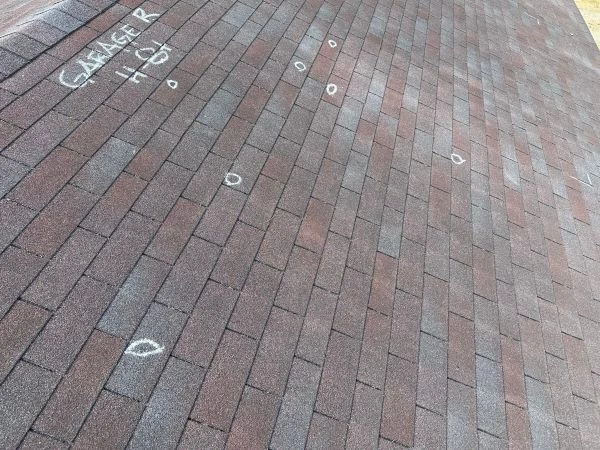
On asphalt shingles, authentic hail damage is typically defined by a distinct impact that changes the shingle structure. The most common signs include:
- Granule displacement in a localized area where the surface looks freshly scuffed or bare.
- A circular or irregular mark that stands out from surrounding wear patterns.
- A “mat” impression where the underlying asphalt or fiberglass becomes visible.
- Softening, cracking, or a compromised seal in the affected spot.
A key clue is consistency. When hail hits a roof, it affects multiple shingles across multiple slopes, often with a directional pattern tied to wind. A single random spot on one shingle rarely tells the full story.
Bruised Shingles and How They Present
Bruised shingles are one of the most misunderstood outcomes of hail. A bruise is not simply a surface scuff. It is internal damage where the hailstone compresses the shingle layers, weakening the asphalt and sometimes breaking the mat beneath. In bright light, a bruise may look like a darkened, slightly indented circle. Under gentle pressure, it can feel softer than surrounding areas.
We look for bruises alongside other storm indicators. If bruises exist but gutters, vents, and soft metals show no impacts, the “hail” explanation becomes less likely. True hail events usually leave a multi material footprint.
Hail Impact Marks on Roof Components Beyond Shingles
Shingles are only one part of the puzzle. We validate hail by checking “test surfaces” that record impacts clearly.
Soft Metals and Accessories
Soft metal components often show the clearest hail evidence:
- Vent caps and roof jacks
- Ridge vents with metal flashing
- Chimney caps
- Drip edge and flashing edges
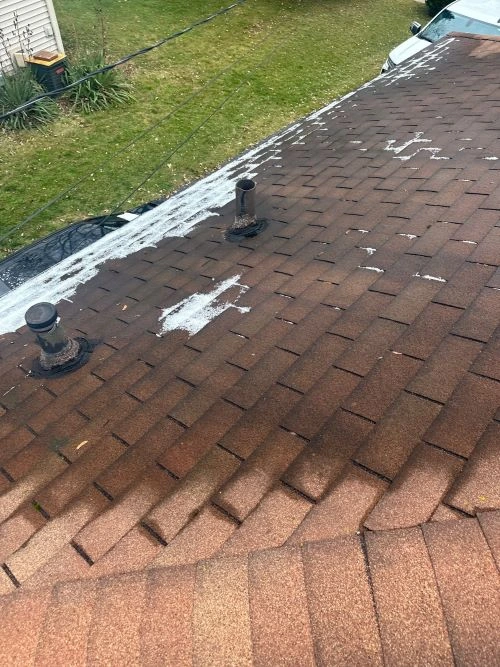
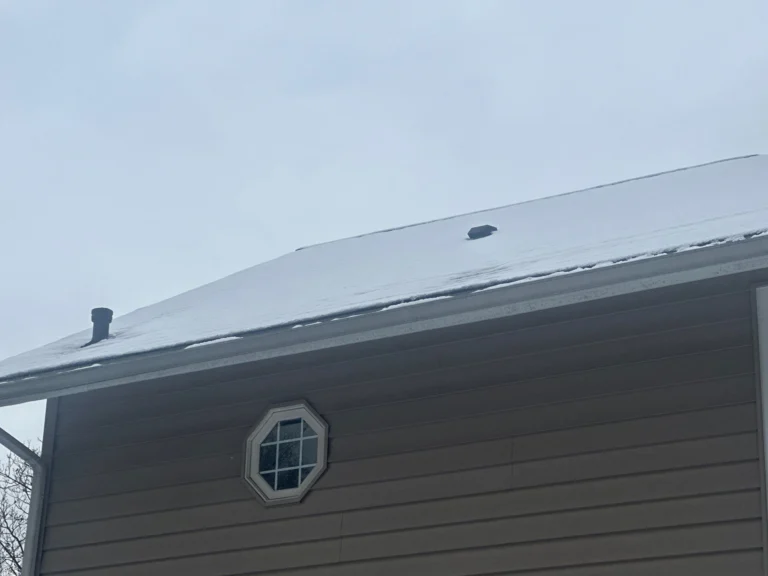
When hail is significant, dents appear as crisp depressions with minimal abrasion. If we find impacts on these metals plus matching shingle strikes, the story aligns.
Gutters, Downspouts, and Fascia
Gutter dents that are evenly distributed on exposed faces are strong supporting evidence. We also check downspouts for linear dent patterns. Random ladder dings or single isolated dents do not usually match hail behavior. Hail typically creates repeated strikes in similar exposure zones.
Siding, Windows, Screens, and Exterior Fixtures
Hail can crack vinyl siding, chip paint on wood trim, pit window screens, and mark outdoor AC fins. When exterior elements show a consistent storm signature, it strengthens the conclusion that roofing marks are hail-related rather than age or foot traffic.
Hail Damage vs Blistering
The phrase hail damage vs blistering comes up constantly because both can show circular marks. The difference is in cause and texture.
Blistering forms from heat, trapped moisture, or manufacturing variables that create raised bubbles in the shingle surface. Over time, those bubbles pop, leaving small craters. These craters are usually uniform, widespread, and not tied to a single storm direction. Hail impacts, by contrast, tend to be larger, more randomly distributed, and associated with other storm indicators such as dented metals and marked gutters.
If the roof displays countless tiny pits across nearly every shingle with no metal dents anywhere, blistering is often the more likely explanation.
What People Often Think Is Hail (But Usually Isn’t)
Many roof conditions mimic hail at first glance. We separate them by pattern, texture, and context.
Granule Loss from Aging
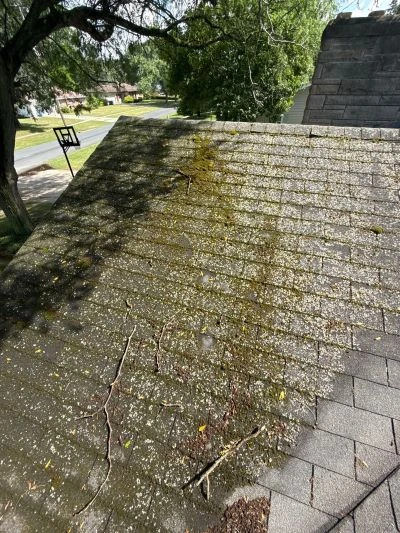
As shingles age, granules release gradually and evenly. You might see accumulation in gutters or at downspout exits. This is not the same as a sudden localized impact area. Aging typically lacks sharp edges and does not create a clean “hit” zone.
Foot Traffic and Maintenance Scuffs
Walking on a roof in hot weather can scuff granules and create crescent-shaped abrasion. HVAC servicing, antenna work, or gutter cleaning can leave repeated scuffs along common walking paths. These marks often line up with access points and do not show the dispersed randomness of a hail event.
Fallen Branches and Debris Strikes
A branch strike can create a dramatic mark, but it is usually singular and may include tearing, puncture, or scraped lines. Hail produces many separate impacts rather than one concentrated injury with dragging or tearing.
Thermal Cracking and Sealant Issues
Heat cycling can cause splits, curling, or sealant failure. These problems look like lines, lifting tabs, or edge cracks, not clean impact marks. Hail can contribute to cracking, but thermal symptoms typically show broader age-related patterns.
How We Confirm Hail Without Guesswork
We rely on repeatable inspection habits, not assumptions. We assess the roof in a way that produces evidence you can understand and photograph.
- We check multiple slopes and elevations. Hail often hits certain faces harder, depending on wind and storm direction.
- We compare shingles and soft metals together. Shingle marks alone can mislead.
- We look for consistent impact sizes. A hailstorm usually leaves a range of sizes, but with recognizable repetition.
- We document density and distribution. Real hail events do not typically affect only one isolated area.
- We note collateral damage. Gutters, vents, siding, and screens provide context.
This is also where the phrase hail impact marks roof becomes important. When the marks on the roof match dents on test surfaces, we have a consistent impact profile.
Numbered Checklist: Clear Signs of True Hail Damage
Below is a practical field checklist we use to decide whether marks are storm-related. Each item should be considered alongside the others, not in isolation.
- Consistent strike patterns across a slope
We look for impacts that repeat in a scattered pattern across the same roof face, not just one or two suspicious spots. True hail commonly affects multiple shingles in a defined exposure area, especially on slopes facing prevailing storm winds. If the marks show up in clusters that align with wind direction and appear on adjacent shingles, the likelihood of hail increases significantly. - Fresh granule displacement with defined edges
A genuine hail hit often removes granules suddenly, leaving a distinct spot with sharper boundaries than normal aging. The surface may look newly exposed compared to surrounding weathered shingles. We compare color contrast, texture, and granule looseness nearby. Even when granules remain, a strike can fracture or loosen them, creating a noticeable difference under close inspection. - Bruising that feels different under light pressure
With bruised shingles, the damage can be internal rather than obvious. We carefully test suspected areas by feeling for soft spots that do not match the firm texture around them. A hail bruise can also show a dark, shadowed look when sunlight hits at an angle. This type of damage usually appears in multiple locations, not as a single isolated oddity. - Dents on soft metal components that match roof impacts
We confirm hail by inspecting vent caps, flashing, and other soft metals that record strikes clearly. If shingles show “hits” but metals are perfectly clean, we pause and reassess. When metal dents are present and similar in size to roofing marks, it strengthens the conclusion of hail. This is one of the most reliable cross-checks available on most homes. - Gutter and downspout denting on exposed faces
Gutters often tell the story because they sit in the open and take impacts directly. We focus on the outer face and the top edges where hailstones strike. True hail dents are typically repeated and spread along the run, not limited to one point that could be ladder damage. We also check downspouts for repeating dents that follow the same storm exposure. - Collateral damage to screens, siding, or outdoor equipment
When hail is strong enough to damage shingles, it often leaves evidence elsewhere. We look for pitted window screens, cracked vinyl siding, chipped paint on trim, and impact marks on exterior fixtures. These indicators help separate hail from roof-only lookalikes such as blistering. A consistent storm footprint across multiple exterior materials is a strong supporting factor. - Impact density that aligns with the storm severity
We document how many impacts appear within a defined area. A few random marks might be incidental, but a meaningful hail event usually produces a measurable density of hits across the affected slopes. We also consider whether damage appears on ridges, hips, and open fields of shingles. This approach helps us avoid overstating damage and keeps documentation realistic and defensible. - Absence of telltale non hail patterns
We actively look for signs that point away from hail, such as widespread uniform micro-pitting from blistering, scuffs along common foot paths, or age-related granule loss across the entire roof. When these patterns dominate and storm indicators are missing, hail is less likely. Identifying what the damage is not can be just as important as identifying what it is.
What to Do If You Suspect Hail Damage
If you think a storm may have affected your roof, we recommend a calm, step-by-step approach:
- Take wide photos of each slope from the ground if possible.
- Photograph gutters, downspouts, vents, and screens.
- Note the date and approximate time of the storm.
- Avoid walking the roof unless you are trained and have proper safety equipment.
- Schedule a professional inspection that includes documentation of both roofing and exterior components.
If confirmed, your next steps may include a claim consultation, a targeted repair plan, or full replacement depending on the extent of impacts and the roof’s age. This is where homeowners often ask about hail damage roof repair options, and the right answer depends on how widespread the impacts are and whether the shingle system has been structurally compromised.
Frequently Asked Questions
Can small hail still damage a roof?
Yes, small hail can still cause damage depending on wind speed, roof age, shingle type, and impact angle. Even hail under one inch can dislodge granules or create subtle bruising, especially on older shingles that have become brittle. We look for supporting evidence on soft metals and gutters to confirm whether small hail had enough force to cause real impact damage rather than normal wear.
How can we tell if marks are hail or just normal aging?
Normal aging typically creates even, gradual granule loss and general weathering across broad areas. Hail tends to create more localized impact zones with distinct boundaries. We compare suspicious spots with surrounding shingles and check for related signs such as dented vents, marked gutters, and collateral impacts on screens or siding. If the roof shows widespread uniform pitting, blistering may be more likely than hail.
Do all roofs show hail damage the same way?
No. Asphalt shingles may show granule loss and bruises, while metal roofs may show visible dents. Tile roofs can crack, and wood shakes may split. Roof pitch, orientation, and wind direction also change how impacts appear. We evaluate each roof system based on its material behavior and verify with test surfaces and exterior evidence, rather than assuming one universal hail “look.”
Can blistering be mistaken for hail damage?
It often is. Blistering can leave small circular craters that resemble tiny impacts, but it usually appears in a more uniform, widespread pattern and lacks supporting storm evidence. In a true hail event, we expect to see corroboration such as dents on soft metals and impacts on gutters or screens. When those are missing, the case for hail becomes weaker, and blistering becomes a more probable cause.
Should we file an insurance claim if we are not sure?
If you are uncertain, it is better to document first and seek a professional inspection before taking action. A clear assessment helps avoid unnecessary claim activity and ensures you have accurate evidence if damage is present. We focus on measurable indicators, consistent patterns, and multi-surface confirmation so your decision is based on facts, not guesswork. A well-documented inspection also supports smoother communication with adjusters.
Closing Perspective
When we know what true hail damage looks like, we avoid mislabeling normal wear, blistering, or traffic scuffs as storm impacts. We also protect ourselves from overlooking subtle but meaningful bruising that can shorten a roof’s life. With careful pattern checking, test surface validation, and clear documentation, we can make confident decisions and move forward without uncertainty. For a thorough evaluation grounded in real evidence, we encourage homeowners to connect with Worthy Construction LLC for emergency roof repair and roofing construction in Kalamazoo, MI.






Trustindex verifies that the original source of the review is Google. Highest praise for all of Worthy Construction. Fantastic service, advice and attention. Full roof installation plus gutters. They kept us informed about everything happening and were done on time. Efficient, quality, professional work. Highly recommended.Trustindex verifies that the original source of the review is Google. Worthy Construction replaced our roof, gutters, and repaired our front steps. Khari was professional start to finish, from taking the time to understand what we were hoping to achieve, preparing and presenting his estimate, and all the way through to his final walk through. Great communication, quality materials and work, and great crews! I recommend Worthy Construction to anyone looking for a high quality local contractor!Trustindex verifies that the original source of the review is Google. Worthy construction Did an amazing job on my roof very fast and reliable I highly recommend his services He helped us out And I appreciate it Definitely deserve 5 stars thanks again Worthy ConstructionTrustindex verifies that the original source of the review is Google. Was a great experience, excellent customer service. Work was completed in a very timely manner. Would recommend their services to anyone.Trustindex verifies that the original source of the review is Google. Worthy Construction just replaced my roof, skylights, and gutters. I live out of town and selling my parent's house so this company came through a personal referral. Khari and team were such a joy to work with. He answered my questions, kept me updated on progress, did everything he said he was going to do, and met all of commitments on time. It's not easy to know what's happening while living out of town and I appreciate Khari's communication skills, timeliness, and overall this has been an amazing experience! I highly recommend Worth Construction!!Trustindex verifies that the original source of the review is Google. Worthy Construction did an excellent job replacing our roof. They were very easy to work with throughout the entire process. They answered all of our questions promptly and delivered a great finished product. I’d highly recommend them for your roofing needs.Trustindex verifies that the original source of the review is Google. Very professional, great guy that will work with you. Highly recommended for sure. Mr. Worthy is very dependable! He completed our roof on time and as expected!Trustindex verifies that the original source of the review is Google. Greatest service ever! Super fast and did a fantastic job. I will definitely save them to do future jobs that need to be fixed. The greatest ever!Trustindex verifies that the original source of the review is Google. My roof was very damaged, I had a huge hole in my roof from constant tree debris and age. I didn’t have any expectations going in to the project but I was greatly impressed with the speed of service! The ten we done in 2 days! They cleaned up afterwards, the materials were great quality and . The team replaced my entire rooftop. Mr. Worthy was very respectful and responsive to my concerns regarding the project, I would certainly recommend his company to anyone looking for a new rooftop!Trustindex verifies that the original source of the review is Google. He was a pleasure to work with. They were prompt and professional the whole project. He kept me informed the whole process and his work was of the highest quality. They were very respectful of my and my neighbor's properties. I am very very happy with the work they did for me.